
Tips to stay motivated by https://www.market-connections.net
Tips To Stay Motivated
Most of us need a little boost every so often.May be you need to figure out how to stay motivated while working from home. May be it has nothing to with working from home. Perhaps you need to figure out how to stay motivated after a setback.
In any case, this report includes powerful tips to stay motivated. It also includes 3 actionable steps you can take right away and a list of suggested reading for those people who are looking for even more information. All I Want To Do Is Sleep No Motivation
Do you ever wake up in the morning, and the last thing you want to do is get out of bed? How about the mornings when you wake up, hop out of bed ready to take on the world? What's the difference between those two scenarios? Motivation.
Define Motivation
Motivation is what compels us to set goals, and more importantly - drives us towards them. Below is a snapshot of how Motivation is defined at Dictionary.com:
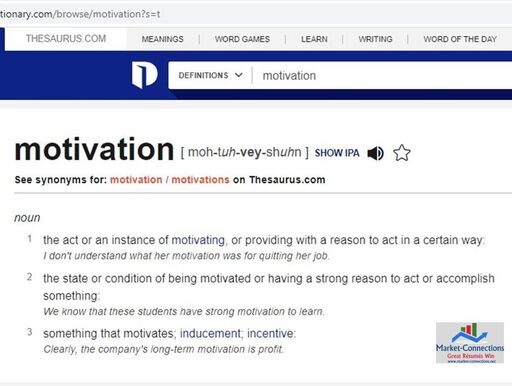
Snapshot of Motivation Definition from Dictionary.com.
Motivation Synonym
Thesaurus.com suggests the following list, each as a motivation synonym.
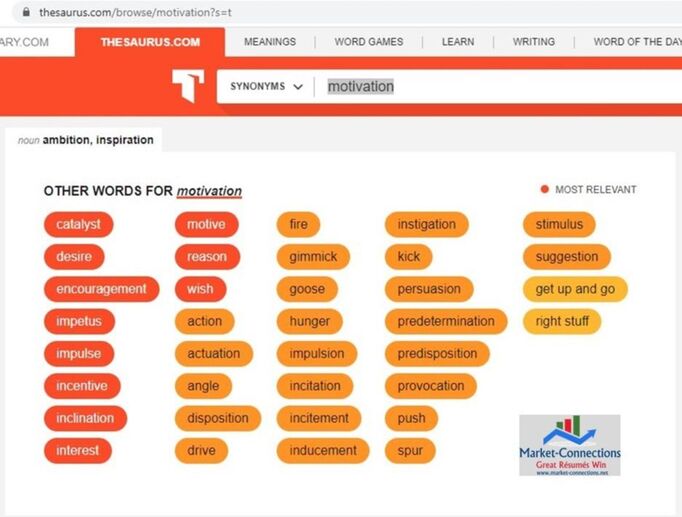
Motivation Synonym from Thesaurus.com
Self Motivation Tips
Read the tips below and use them to learn how to tap into the power of motivation.
1. Know What You Want What is the point of motivation if you don't know what you want? Without having a clear vision of exactly what you desire, you won't be able to build up enough motivation to get through the obstacles you are sure to face. 2. Know Why You Want It This step is just as important as knowing what you want. Why do you want to reach specific goals? What will it mean to your life? Think about all the people in your life that you don't want to let down. These are the "whys," and they are essential. 3. Set Goals That Excite You It's beneficial to set reasonable goals that are easy to reach. I would never suggest stopping that. However, it can also help to set some relatively wild or audacious goals. These goals might seem out of reach right now, but the allure of reaching them in the future might motivate you in the present. 4. Track and Measure Your Results Tracking and measuring your progress is key to motivation. Learn about using tools to use to measure your goals. When you can actually see your efforts paying off, your motivation will naturally rise. If you don't track and measure, how else will you know if you are making profess? 5. Reward Yourself If you are tracking your progress, make sure you reward yourself at least once daily. Rewarding yourself will ensure that you stay motivated. You are more likely to keep plugging away when you can see that reward getting closer and closer. 6. Use Your Social Circle Building accountability through your social circle is a great idea. When you have a big goal you want to achieve, let the people in your life know. Besides them potentially helping you along the way, it will also make you more accountable. The funny thing is, we are more likely to let ourselves down than our loved ones. Revive your network and leverage the power of connecting with others. 7. Fake It Not feeling motivated or energetic today? Try faking it. This tactic won't work all of the time, but it could help you get through a slow morning or two. Pump yourself up with some music. Chug some coffee. Jump around if you have to. Anything to make yourself feel a bit more energetic. 8. Take Action Have you ever sat down to work, and you just couldn't get started? Sometimes all it takes to give your motivation a little boost is to accomplish one simple task. Pick the single, most straightforward thing you can do towards any of your goals and do it. Most likely, this will motivate you to take on the next challenge. 9. Find Your Inspiration People get inspired by different things. If you want to maximize your motivation, then you need to figure out what inspires you. Maybe it's a specific type of music. Perhaps it's a view from your house. It could be a motivational speaker or celebrity. Find out what inspires you and schedule some time to immerse yourself in it each day. YouTube is a great resources. Search for motivational videos. 
Tips to Stay Motivated
Actionable Tips
Suggested Reading

Resume writing tips by https://www.market-connections.net
Writing a resume tips
Starting your resume can seem like a complicated task but it doesn't have to be. When you are creating your resume, you want to make it the most powerful statement that you can about yourself. You want your resume to highlight your strong points that make your resume stand out from the others. Remember that you can make changes to it once you get something on paper and can revise it as you see fit.
Here is a list of tips for resume writing: Tips on resume
The Cost Of Unemployment
The Cost of Unemployment
Have you ever stopped to consider the cost of being unemployed? The longer you are out of work, the more costly it is. Here are some things you may — or may not — have considered as the “cost of unemployment.”
Lost Wages
Loss of income is the most obvious cost of unemployment. Unemployment benefits – if you’re eligible for them — only cover a portion of your lost income. According to research by Newsweek, basic unemployment benefits average $300-$400 a week, typically covering 45 percent of a worker’s income. Severance pay, if offered, can help, but a long period of unemployment can outlast that as well.
Cost of Insurance
According to the 2019 Census, 55 percent of Americans have employer-paid health insurance. Research from the Kaiser Family Foundation found the average annual single premium per enrolled employee for employer-based health insurance was $6,972 per year in 2019, with the employee contributing $1,489 of that, and the employer paying $5,483.
While the Consolidated Omnibus Budget Reconciliation Act (COBRA) health insurance program allows eligible employees and their dependents to continue their health insurance coverage for 18 to 36 months after a job loss, the entire cost of the premiums is the responsibility of the individual. Based on the average, that means you would be responsible for paying almost $600 a month in health insurance premiums to keep your existing coverage. If COBRA coverage is not available, individuals can obtain insurance through the government’s Healthcare Marketplace, but that coverage can be expensive. A short-term health insurance policy may be more affordable, but may have a higher deductible and limited coverage. Going without healthcare insurance is risky financially. Medical bills are reported to be the number one cause of U.S. bankruptcies, and being uninsured can lead to significant out-of-pocket expenses. Lost Retirement Contributions
If you were contributing to your company’s retirement plan — especially if your contributions were matched by your employer — consider the financial impact of missing out on adding to your retirement savings. Every $500 missed could be worth up to $1,300 (assuming 5 percent growth over a 20-year period). Missing out on six months’ worth of retirement contributions could equal almost $8,000 in lost retirement income.
Increased Stress and Anxiety
According to CNBC, 63 percent of households report living paycheck to paycheck, meaning the loss of even one month’s salary could cause severe financial insecurity. Eight in 10 people say they currently can’t cover a $500 emergency. Research also shows that unemployment is linked to anxiety and depression, among other negative outcomes.
Negative Impact on Future Salary
When you’re unemployed, you may take a lower-paying job while negotiating your salary, just to get back into the job market. However, don't forget to think about the day when you may need to have a conversation about getting the raise you deserve. Since future raises are based on your new (lower) starting salary, you may find yourself missing out on tens of thousands of dollars of future income.
For example, if your original salary was $50,000, and you received annual raises of 3 percent, after 5 years, your salary will be $56,275. If you took a job that paid $45,000 and you received annual raises of 3 percent, after 5 years, your salary will be $50,647 — barely what you were making when you left your previous position. You would have also missed out on $26,544 in pay during those five years ($265,453 from the starting salary at $50,000 plus 3 percent raises minus $238,909 – five years of salary starting at $45,000 with a 3 percent annual increase). You may also make poor financial decisions out of desperation. For example, you might cash out your 401(k) fund to free up some cash to cover your living expenses. However, with limited exceptions, if you withdraw money from your 401(k) retirement account before the age of 59-1/2, you will pay a 10% early withdrawal penalty, plus income tax, on the distribution. For someone in the 24 percent tax bracket, an early withdrawal of $5,000 will cost $1,700 in taxes and penalties. In addition, you’ll lose out on the future growth of that $5,000. Invested for 20 years at 5 percent, that $5,000 would have grown to more than $13,000. The best thing you can do if you find yourself unemployed is to get back to work quickly:
How To Prepare For Unemployment
First — and most important — keep your résumé up-to-date and ready to go. Not only is it easier to pay for résumé services when you’re employed, but you won’t lose valuable time getting started with your job search. It can take anywhere from a few days to a few weeks to create an interview-winning résumé and portfolio of career documents. The sooner you are able to start your job search, the closer you’ll be to going back to work. Also, the longer you are unemployed, the harder it is to find a new job.
Second, have an emergency fund. One of the biggest struggles with unemployment is losing your income. Unemployment benefits — if you’re eligible to receive them — can take weeks to get approved. In the meantime, having an emergency fund — even a small fund of 2-4 weeks of expenses — is better than nothing. Most experts recommend having 3-5 months of savings. Third, the best offense is a good defense. If you think you’re in danger of losing your job, batten down the hatches. Make a list of your current expenses (review your checkbook register, credit card statements, or online banking profile) and see what you can cut out. You may have to prepare for a financial apocalypse. Determine which of your current monthly expenses must be maintained (mortgage and car payments, utilities, groceries) and which ones you can do without for now. Eliminate any unnecessary expenses. Finally, it can be easier to find a job when you have a job, so don’t wait until you lose your job to start looking. And take the advice of author Harvey Mackay and “Dig Your Well Before You’re Thirsty” and cultivate your network while you’re still working. Learn how to use LinkedIn. Get a FREE LINKINEDIN SCORECARD. Review your professional and personal connections and try to revive your network . After all, the cost of unemployment is high. Higher than you may have thought.

Best online college programs
Getting a college degree online has become a very practical reality, as we continue to move on through the worldwide COVID pandemic. Today there are countless options for getting yourself an online education, depending on your specific needs and goals. If moving on up is on your list of priorities, then an accredited degree may facilitate the process for you significantly.
Below are some key points to review when trying to identify the best online college programs that will suit your plans. Be clear about your needs
Different people have different needs for getting an online education. Before you begin looking at universities, do some introspection to determine what kind of education you seek, how you can schedule your online education to fit into your routine, how much time and effort you are prepared to spare and whether it is personal fulfillment or career advancement that you aim to achieve through the course. Chances are high you will have to leave your comfort zone behind.
If your new degree is related to your career, it will become even more significant next time you negotiate your salary, or next time you think about getting the raise you deserve. Investigate your options
The internet has an abundance of online education offers for every conceivable purpose. So take the time to gather information about the options that suit you. Most schools provide free information kits on their education programs that can help you get a better idea of what’s in store if you choose to enroll with any of them. You have the option of conducting searches according to the type of courses you are interested in and college rankings. Make sure you have a clear idea of the program being offered before you invest your hard earned money and time into any one of them.
Be wary of scams
As with all offers on the internet, there is no dearth of scams that you need to be wary of when doing your searches for the right course. If you’ve heard about a course through a spam e-mail, steer clear of it. Fake degrees and credentials are plentiful and you’ll only be wasting your time, effort and money if you are not careful.
What are the support services
Different online courses have different support services to offer their students. Many offer services like tutoring, reference links, library access, technical assistance, discussion threads, interaction with fellow students and a variety of other features. Depending on the kind of study aids that are likely to benefit you, make your choice based on the kind of facilities you can avail once you enroll for a course.
Look for accreditation
Accreditation of the school or institute that you enroll in, is of vital importance. After all if the reason you are pursuing further education is to advance your career, the degree you will be earning needs to be recognized by your employers or prospective employers.
ACCREDITED ONLINE COLLEGE COURSES
There is a wealth of information available online regarding many different aspects of the education process, including how to apply for financial aid, how to choose the right college and more. Since the spread of COVID-19 and the worldwide pandemic, almost everyone is seeking to earn their degrees completely online. What many students fail to research however is the accreditation process, which is incredibly important .
An accredited degree entails that you’ve received a certain level of quality in your education. There are many “diploma-mill” type schools on the internet that promise you’ll receive original degrees in half the time of a traditional learning institution. It has been reported that they make these claims in an attempt to enroll you. More often than not, you may be left with a degree that hasn’t been through the proper accreditation process. What’s more, all of the money and hard work you spent getting the degree is for naught, because a degree that isn’t accredited isn’t recognized as a legitimate proof of your academic endeavors. Properly accredited online diplomas ensure a student is receiving the type of quality education that is the standard among colleges and universities both online and offline. What’s more, accreditation holds educational institutions accountable for their actions, as well as ensures confidence. Holding original degrees that have been fully accredited by the proper governing boards ensures that your hard work has paid off, and will continue to do so in the future. What’s more, employers and other learning institutions will accept your degree without a problem, even if it’s been obtained online, provided it’s been accredited. Accreditation is highly important for students for several other reasons as well. For example, students who wish to apply for financial aid can only do so if their school is properly accredited by the correct educational boards. Additionally, in order to transfer your credits to another educational institution that’s accredited, you have to receive a degree from an accredited school online. Original degrees are the only universally accepted proof of educational merit, and employers may question those who failed to receive a degree that was accredited. Many potential students fail to understand the importance of accreditation. They are misleading into believing that all online degrees are the same, however, this is extremely far from the truth. Fake or instant degrees are virtually worthless in the eyes of employers. Not only are they a waste of time, they are also a waste of your hard earned money. The bottom line is that you must do your research thoroughly before committing to any online college, and ensure that the degree you will obtain is properly accredited through the correct state or regional boards. Doing so will save you a lot of money, time and hard work in the long run.
|

Award-winning resume writing services
Categories
All
powered by Surfing Waves
AuthorMandy Fard is a Certified Professional Resume Writer (CPRW, CMRW) and Recruiter with decades of experience in assisting job seekers, working directly with employers in multiple industries, and writing proven-effective resumes. 
Archives
July 2024


|

-
Greater Los Angeles
and Kern County
-
[email protected]
.


 RSS Feed