
Use your hobby to advance your career - Posted by https://www.market-connections.net
Discover How Your Hobby Can Advance Your CareerCreative hobbies can improve job performance
Have you been thinking about a creative career related to your hobby?
A recent study at San Francisco State University looked at how creative hobbies like knitting, cooking, painting, photography, gardening or other similar activities affect work performance and results showed that what you do in your leisure time could make you a more valuable employee. Findings were published in the Journal of Occupational and Organizational Psychology. People who use their free time creatively performed better at solving problems at work and were more helpful to their colleagues, according to researchers at San Francisco State University. They believe creative activities stimulate learning and help people to feel energized and engaged. The study’s Lead Author was Dr. Kevin Eschleman. The question is: Are YOU ready to make the connection between your hobby and your career? Consider these suggestions about using your hobby to get ahead at the office. How to choose a hobby that can help your career
How to use your hobby to help your career
Of course, your hobby is rewarding in itself even if your boss doesn’t share your enthusiasm for its details. Advancing your career is just a bonus compared to the deeper benefits of learning about yourself and becoming more accomplished.
powered by Surfing Waves

How to optimize your LinkedIn profile in 2020 - Posted by https://www.market-connections.net
Optimize your LinkedIn profile - 2020
Almost 95% of recruiters use LinkedIn to search for candidates, but most job seekers are overlooking this valuable opportunity.
If you’re like many professionals, you probably created a profile and occasionally go back to add more connections. However, there is so much more you can do with this platform to advance your career. Tips to optimize and design your LinkedIn profile
Take charge of your future and attract more attention from potential employers. Try these tips for designing and using your LinkedIn profile.
Designing your LinkedIn Profile:
Using your LinkedIn Profile:
Optimize your LinkedIn profile and increase your visibility. It can make it easier for others to find you and help you reach your professional goals. AuthorMandy Fard is a Certified Professional Resume Writer (CPRW, CMRW) and Recruiter with decades of experience in assisting job seekers, working directly with employers in multiple industries, and writing proven-effective resumes. 
20 Places to find remote jobs in 2020 - Posted by https://www.market-connections.net
A guide to find remote jobs onlineWhere to find legit jobs online
Here is a list of 20 places where you can find and apply for remote jobs. If you’re trying to start a freelance career or hoping to nail down a remote job, these websites are a great place to start looking.
Some of these sites are free, while others are paid membership sites. Job Search Apps
FULL RESOURCES (Updated September 2022):
November 2019: 12 Quick and easy ways to make money online March 2020: 62 Places to Find Remote Jobs Online. April 2020: 12 Quick and Easy Ways to make Money Online. February 2022: Bit Coin Jobs. September 2022: Real Ways to Make Money From Home for Free.
powered by Surfing Waves

How to become successful - Brought to you by https://www.market-connections.net
What does it take to be successful?
If you’ve ever known anyone ultra-successful, you know that they can appear to be a different breed. We’re not talking about someone that’s a straight-A student and goes on to make $250,000 per year. We’re talking about people that win gold medals, become billionaires, or impact the entire world in some way.
These ultra-successful people are all unique, but they share many of the same habits. Mimic these habits of successful people and become more successful yourself: 7 Habits of Ultra-Successful People
1. WAKE UP EARLY. The vast majority of the most successful people in the world get up very early. They make great use of this time, too. They have a morning routine that often includes exercise and meditation or prayer.
2. PRACTICE SELF-DISCIPLINE. Success requires work. High levels of success require doing work that most people aren’t willing to do. It takes self-discipline to do difficult things day after day.
3. BECOME ACTION-ORIENTED. People with mediocre levels of success often like to plan, but they struggle to actually take any sort of action. Successful people take intelligent action. They are the masters of getting things done. They’re also great at getting started on new projects. 4. READ DAILY. Reading saves years. Without reading, you’re forced to figure out a lot by yourself. A book written by a competent author is like a mentor. The world is full of experts. Why try to do it all yourself? Stand on the shoulders of the world’s all-time greats.
5. GET CLEAR ON YOUR GOALS. Ultra-successful people know exactly what they want. The average person does not. You can’t make progress toward a goal if you’re not aware of your goal.
6. SAY “NO” TO PRACTICALLY EVERYTHING. Highly successful people avoid distractions much better than the average person. Many of us say “Yes” to almost every opportunity. Successful people say “No” almost all the time.
7. PERSEVERE. The most successful people have a tenacity that most of us fail to demonstrate. We give up far too easily. You may even have to leave your comfort zone behind.
Your habits largely influence how successful you’ll become. Effective habits result in great results. Poor habits lead to undesirable results. One of the most effective ways to take your life to the next level is to create habits that support your goals.
The most successful people in the world have the best habits for success. Pick up a couple of these habits and integrate them into your life. You’ll be glad you did!
powered by Surfing Waves

Considering the costs of a career change
Considering the costs of a career changeWhat does a career switch cost?
You’ve been thinking about a career change for a long time. You’re bored with your job and you’re not progressing at the office. You’ve considered your career options. Frankly, you’ve wanted to do a particular type of work since you were 20 but it just wasn’t in the cards.
Perhaps this is the right time for a career change. Are you financially prepared to switch? Ponder these points before you go after the job of your dreams: 1. What don’t you like about your current job? It’s important to clarify why you’re unsatisfied with your job.
2. Will you need training or education for your new career and how much will it cost? What do you need to know to be successful in the work? How will you obtain the knowledge or skills? It might take some time and money, so it’s wise to make an achievable plan. 3. Do you have money saved to help you through the transition? If you’ll require some training or time to hone skills, you’ll be working on those things and not bringing home the bacon. Therefore, you’ll need some cash stashed for living costs.
4. Do your research upfront. Before you leave your current position, do your homework. Find out what people earn who do the work you desire. Will you experience a pay reduction?
5. What will switching careers mean in terms of your health insurance? As you know, healthcare is expensive. Therefore, consider what will change about your health insurance, if you switch jobs.
6. Is it possible to start saving big now? In the event you’re pondering a job change, you can expect to experience some personal and financial upheaval if you decide to switch careers. It makes sense to start saving extra money now to pad your emergency fund.
If you consider all these points when thinking about making a career change, you’ll be as financially prepared as you can once you decide to take the leap into an exciting, new job.
powered by Surfing Waves
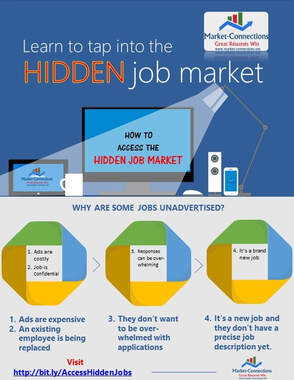
How to tap into the hidden job market
What is the hidden job marketFinding unadvertised jobs
You may have heard the term “the hidden job market.” What is it, and how do jobseekers get access to it? The “hidden job market” is a phrase that describes job openings that are not publicly advertised.
Why would companies not publicly post a job opening?
Most of these job opportunities are accessed through referrals from current employees of the company. It’s estimated that 60-80 percent of jobs are found through professional networking. While not all of the jobs found through professional networking are accessing the hidden job market (after all, your friends/family/acquaintance network can help you access interviews for advertised opportunities too), almost all candidates who get interviews for unadvertised jobs do so through networking. Current employees can be an excellent source of candidates. Particularly if the company has a strong workplace culture, having existing employees identify prospective candidates can help ensure solid candidates are encouraged to apply. Some companies even reward employees — with cash or gift cards — for recommending a candidate who is eventually hired. Employee referrals provide an advantage for the jobseeker too. Employee recommendations can carry great weight. Plus, there is less competition for job opportunities accessed through the hidden job market than for openly advertised opportunities. Being referred by a current employee may also mean that your application is set apart from the typical internal processes that most jobseekers have to navigate — such as an applicant tracking system for online applications. Recruiters are another source of unadvertised positions. An employer may choose to work with a recruiter to fill a job rather than advertise it publicly. The recruiter sources job candidates, screens prospective hires, and sends the hiring manager a handful of handpicked candidates. This saves the company time and money. In many cases, when working with a third-party recruiter, the company only pays the recruiter if a candidate is hired, and only if he or she stays for a specified period of time (say, six months). So how do you tap into the hidden job market? Because opportunities are filled both through employee referrals and recruiting, you will want to cover both bases. Accessing the hidden job market works best when you have a clear target in mind — either a specific job title or, even better, a specific list of companies you’d like to work for. There are basically three ways to access the hidden job market:

Tap Into The Secret Job Market
Specific tips on how to tap into the hidden job market
While you are logged into your LinkedIn account, go to the company page and see if you have any existing connections with current or former employees: 
How to tap into the hidden job market
While you are logged into your LinkedIn account, do a search for recruiter + [company name]: 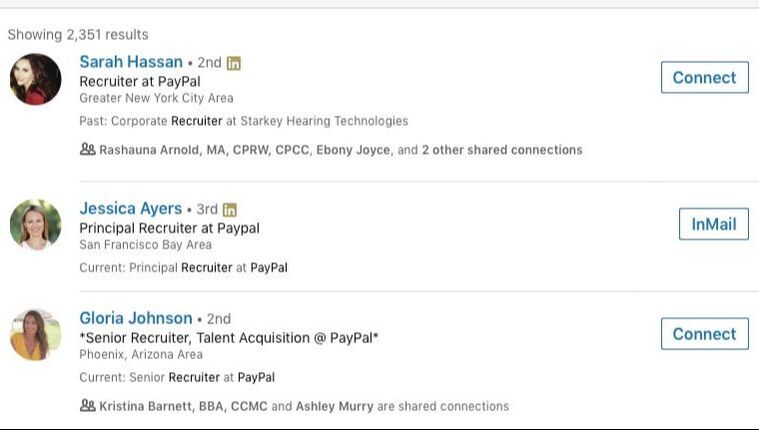
How to tap into the hidden job market
Remember, exploring the hidden job market is just one possible way to connect with your dream job. It’s a strategy that can pay off handsomely, but will often take longer than simply identifying advertised openings and applying. However, you will likely find there is less competition for the job opportunity, and if you are using an “inside source” — either a current employee or an internal recruiter — your likelihood of landing an interview can be higher than seeking out a traditionally advertised opening. Action Items
powered by Surfing Waves

What is a Leader? Leadership definition brought to you by https://www.market-connections.net
How to develop leadership skillsIt is important to develop leadership skills regardless of whether or not you are aiming for the next promotion or if you are at a senior management level. We can all think of at least one natural-born-leader in our circle of connections. But how do you develop those skills if you are not a natural-born-leader? Feel free to consider the details in the video below to help you develop great leadership skills. 11 Principles Of Highly Effective Leadership
How to find a job during the Holiday Season
How to find a job during the Holiday SeasonA strategic guide for job searching during the holidaysJob hunting is always tough but the holiday season can require an even more strategic approach. These are some basic principles and concrete steps to take for making the most of the special opportunities that exist at this time of year. Basic principles for Holiday job searching
Holiday Job Hunting Strategies
It may feel especially unpleasant to be unemployed during the holidays when the rest of the world seems to be celebrating. Be kind to yourself to manage your emotions and relieve stress while you play an active role in building a better career future.
|

Award-winning resume writing services
Categories
All
powered by Surfing Waves
AuthorMandy Fard is a Certified Professional Resume Writer (CPRW, CMRW) and Recruiter with decades of experience in assisting job seekers, working directly with employers in multiple industries, and writing proven-effective resumes. 
Archives
July 2024


|

-
Greater Los Angeles
and Kern County
-
[email protected]
.
 RSS Feed